Building a Future with Dignity: A Tale of Sabina
I have wanted to stand on my own feet from the very beginning of my married life. I grew up in poverty and was married off at a very young age because my family couldn’t afford much. Since then, I’ve always wanted to build a better life and become self-reliant.
My name is Sabina Akhter. I live in Dighirpar, Maheshwarpasha, on the outskirts of Khulna city. I have two children, a son and a daughter, who attend a local model madrasa in the same area. Before this opportunity came, I earned a little by doing tailoring work for women in my neighbourhood. I had to go from house to house looking for orders, and there were months when I barely earned enough to make a difference. My husband drives an inter-district bus on the Khulna-Dhaka route, and together our monthly income was around Tk 10,000 to 15,000. We managed somehow, but there was never any certainty about tomorrow.
“What was hardest wasn’t only the lack of money,” Sabina explains. “I didn’t feel secure in my work. I wanted to earn in a way that people respected—a job where my skills had value and where I could contribute to my family with confidence.”
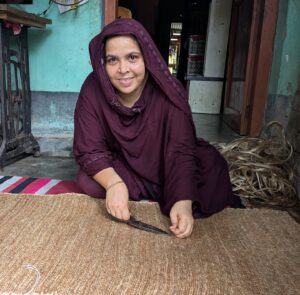
Everything began to change when she heard about the jute handicrafts training offered by BaSE Bangladesh Handicrafts with support from the Bangladesh Youth Employment Consortium (BYEC). Believing this could be the opportunity she had been waiting for, she enrolled in the month-long training from 13 June to 12 July.
“I didn’t know exactly what to expect,” she recalls. “But I knew I couldn’t miss the chance.”
The training has now ended, and although Sabina’s journey has only just begun, the first signs of change are already visible. She has been engaged by BaSE as a contracted home-based producer, giving her access to regular work without having to search for customers door to door. During her very first month, she completed five jute floor mats measuring 140 × 60 centimeters and earned Tk 1,400 for each one.
“When I received my first earnings from this work, I felt something I hadn’t felt before,” she says. “It wasn’t just the money. It was the feeling that I finally have a skill that people value. For the first time, my dream of becoming self-reliant feels real.”
Sabina knows that one month’s income will not transform her life overnight. But it has transformed the way she sees her future. She now imagines a day when she can contribute steadily to her family’s income, save money for unexpected needs, and help secure a better future for both of her children. Asked whether she would choose to invest more in her son’s education than her daughter’s, she smiles and answers immediately:
“My son and my daughter are equal to me. I want both of them to study and have opportunities that I never had.”
The change is also becoming visible beyond her own household. Women from her neighbourhood have started asking about the training and how they might join. Sabina happily shares her experience, believing that more women deserve the same opportunity.
“I’ve already encouraged around ten or twelve women to find out about the training,” she says. “If this opportunity can change my life, maybe it can change theirs too.”
Today, Sabina does not claim that she has achieved everything she dreamed of. Instead, she says she has finally found a path worth believing in. For the first time, she is earning through recognised skills, working with dignity from her own home, and beginning to build a future with greater confidence. The journey towards self-reliance is still unfolding, but for Sabina Akhter, it has finally begun.
Story: 2
Turning Local Resources into Income: Moumita’s Journey Towards Dignified Self-Employment
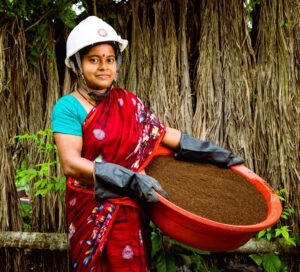
Moumita Dhali, a 25-year-old mother of two from Mirjapur village in Dumuria Upazila, Khulna, struggled to contribute to her family’s income while caring for her children. Her family depended mainly on agriculture, daily wage labour, and occasional milk sales from their two cows. With a monthly household income of around BDT 10,000, meeting family expenses and purchasing cattle feed was difficult. After the birth of her children, Moumita could no longer work as a day labourer and needed an income-generating opportunity that would allow her to remain at home.
With support from the Bangladesh Youth Employment Consortium (BYEC), she participated in organic compost production training from May to July 2026 organized by Build Better Ltd. A partner company of BYEC in Khulna. Using cow dung and agricultural waste available to her family, she started producing organic compost for local farmers. Between May and August 2026, Moumita produced approximately 1,800 kg of compost, with an estimated market value of BDT 34,200. She sold around 1,200 kg at BDT 19 per kilogram, generating sales revenue of BDT 22,800. Her family also used some of the compost on its own land, reducing the need to purchase compost from local markets for vegetable cultivation.
Organic compost production has provided Moumita with an opportunity to earn through her own efforts while continuing to care for her children. The activity contributes to her family’s household expenses, makes productive use of locally available resources, and helps reduce farming costs. It has also strengthened her confidence in her ability to contribute economically to her family.
“Selling compost has given me an opportunity to earn an income while continuing to care for my children at home,” says Moumita.
Moumita’s experience demonstrates how skills training and the use of locally available resources can create practical opportunities for dignified self-employment. By developing a home-based livelihood activity, she has begun generating income while balancing her family responsibilities.